Long-Distance Bulk Transport: Optimizing Cement and Fly Ash Pneumatic Conveying with Screw Blowers
Release time: Sep.03.2026
Click volume: Views
In the cement manufacturing, ready-mix concrete, and thermal power plant industries, the continuous long-distance transport of abrasive dry bulk solids—such as cement powder and fly ash—is a critical operational pipeline. Pneumatic conveying systems account for up to 40% of total electrical energy spent in material handling facilities. Historically, plants relied on multi-stage Roots blowers or low-pressure rotary compressors to fluidize and push bulk materials through dense-phase or dilute-phase pipelines.
As transport distances expand beyond 200 to 500 meters, legacy Roots blowers reach their pressure limits (typically under 100 kPa / 1 bar), leading to line plugging, thermal degradation of pipe walls, and severe power spikes. Upgrading to Positive Displacement Oil-Free Screw Blowers provides the higher pressure ratios (up to 1.5–2.0 bar) and internal air compression needed to maintain stable, high-capacity conveying while cutting energy consumption by 15% to 25%.
1. Core Challenges in Long-Distance Bulk Powder Transport
Moving dense abrasive materials like cement (bulk density 1.1–1.6 ton/m3) and fly ash (bulk density 0.8–1.0 ton/m3) over long distances requires overcoming line resistance, bend friction, and material head losses without causing velocity drops that lead to pipe blockages.
+-----------------------------------------------------------------------------------+
|                     MATERIAL HANDLING FACILITY ENERGY USAGE                       |
+-----------------------------------------------------------------------------------+
|  [ Pneumatic Conveying / Air Supply ] ====================>  35% - 45% Total kWh  |
|  [ Grinding, Milling & Crushing ] =======================>  30% - 40% Total kWh   |
|  [ Silo Aeration, Blending & Auxiliary ] ================>  15% - 25% Total kWh   |
+-----------------------------------------------------------------------------------+
The Technical Bottlenecks of Legacy Blowers in Powder Conveying
Lack of Internal Compression: Roots blowers rely on external pressure buildup. Operating above 70–80 kPa causes extreme thermal expansion, internal slip, and drastic drops in volumetric efficiency.
Line Plugging and Unstable Air Velocity: When system backpressure spikes due to high material loading or long pipe runs, traditional blowers suffer flow degradation, causing dry powders to drop out of suspension and plug the line.
High Discharge Air Temperatures: Overheating discharge air (often exceeding 120°C–140°C in legacy units without massive coolers) can compromise pipe linings, degrade material characteristics, and increase line expansion strain.
2. Comparative Technology Matrix: Roots Blowers vs. Oil-Free Screw Blowers
Technical & Operational Metric | Traditional Roots Blower | High-Efficiency Screw Blower |
Compression Principle | External Compression (Isochoric) | Internal Screw Compression (Polytropic) |
Maximum Discharge Pressure | Up to 98 kPa (1.0 bar) | Up to 150 – 200 kPa (1.5 – 2.0 bar) |
Energy Efficiency Savings | Baseline | 15% – 25% Reduction in Energy Use |
Temperature Rise Control | High (Requires Heavy Air Coolers) | Low Discharge Temp (Superior Rotor Design) |
Pressure Stability under Load | Sensitive to Backpressure Spikes | Constant Volume Flow under Variable Pressure |
Pneumatic Conveying Phase | Dilute Phase Only (< 100 meters) | Dilute & Continuous Dense Phase (Up to 500m+) |
Noise Level | 85 – 100 dBA (High Pulsation) | < 75 – 82 dBA (Smooth Pulsation-Free Air) |
3. Mechanics of Energy Savings in Screw Blower Conveying
1. Internal Air Compression via Precision Helical Rotors
Unlike Roots blowers that forcefully push atmospheric air against system pressure, screw blowers feature male and female helical rotors that progressively trap and compress air inside the main housing. This internal compression process eliminates sudden backflow shock, requiring significantly less shaft power to deliver high pressure air into the pneumatic pipeline.
   [ Intake Ambient Air ] ---> [ Male & Female Helical Rotors ]
                                           |
                                [ Progressive Internal Compression ]
                                           |
                              [ High-Pressure Air Discharge ]
                                           |
                     [ Stable Long-Distance Conveying Pipeline ]
2. Constant Volume Flow Prevents Line Blockages
Cement and fly ash conveying lines experience dynamic pressure fluctuations as material slugs move through bends. Screw blowers act as true positive displacement machines: even if line pressure rises from 80 kPa to 130 kPa, the delivered air volume remains practically constant. This prevents velocity drops, ensuring material stays suspended throughout long transport distances.
4. Financial Return on Investment (ROI) Case Analysis
Baseline Plant Parameters
Application: Fly Ash Transport from Power Plant to Storage Silo
Conveying Distance / Capacity: 350 meters / 45 tons/hour
Air Volume Required: 42 m3/min
Required Line Pressure: 130 kPa (1.3 bar)
Electricity Tariff: $0.12 / kWh
Operating Hours: 8,000 hours/year
Energy & Cost Comparison Calculation
+-----------------------------------------------------------------------------------+
|                        ANNUAL ELECTRICITY COST COMPARISON                         |
+-----------------------------------------------------------------------------------+
|  High-Pressure Roots Blower Setup:  132 kW  --->  $126,720 / Year                 |
|  Oil-Free Screw Blower System:       102 kW  --->  $97,920 / Year                   |
|  -------------------------------------------------------------------------------  |
|  NET ANNUAL ENERGY SAVINGS:          30 kW   --->  $28,800 / Year (22.7% Savings)  |
+-----------------------------------------------------------------------------------+
ROI & Payback Timeline
Capital Investment Differential: Upgrade to high-efficiency screw blower package ≈ $32,000 – $38,000.
Annual Energy Savings (OpEx): $28,800 / year.
Reduced Unscheduled Downtime: Preventing line plugs saves an estimated 40+ hours of operational disruption per year (approx. $8,000 in saved labor and throughput recovery).
Simple Payback Period: Dividing the $35,000 investment by $36,800 in combined annual savings yields a payback period of approximately 0.95 Years (11.4 Months).
5. Industry-Leading Screw Blower Solutions by Shandong Huadong Blower Co., Ltd.
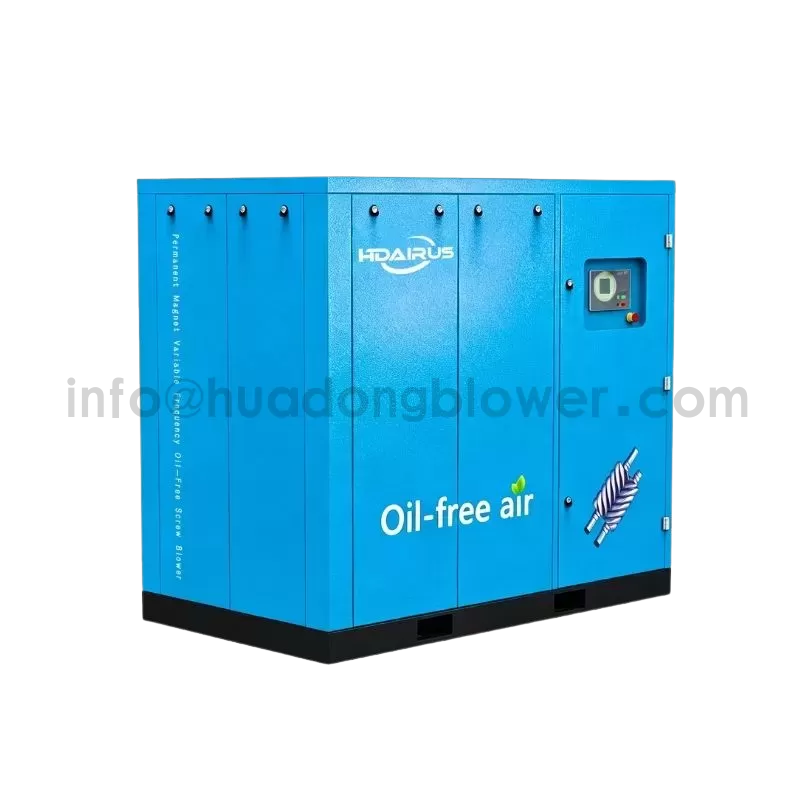
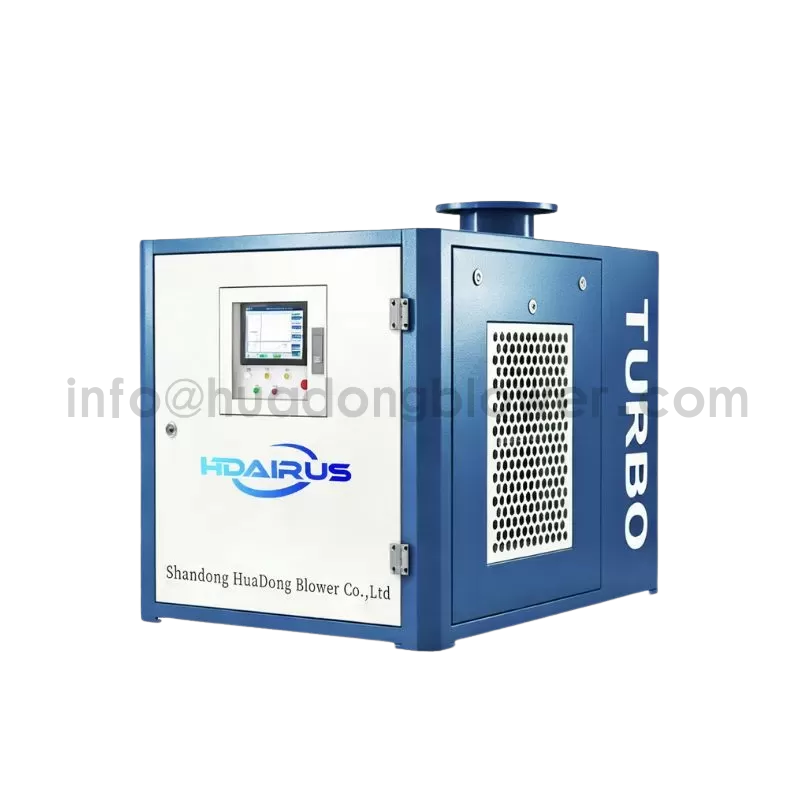
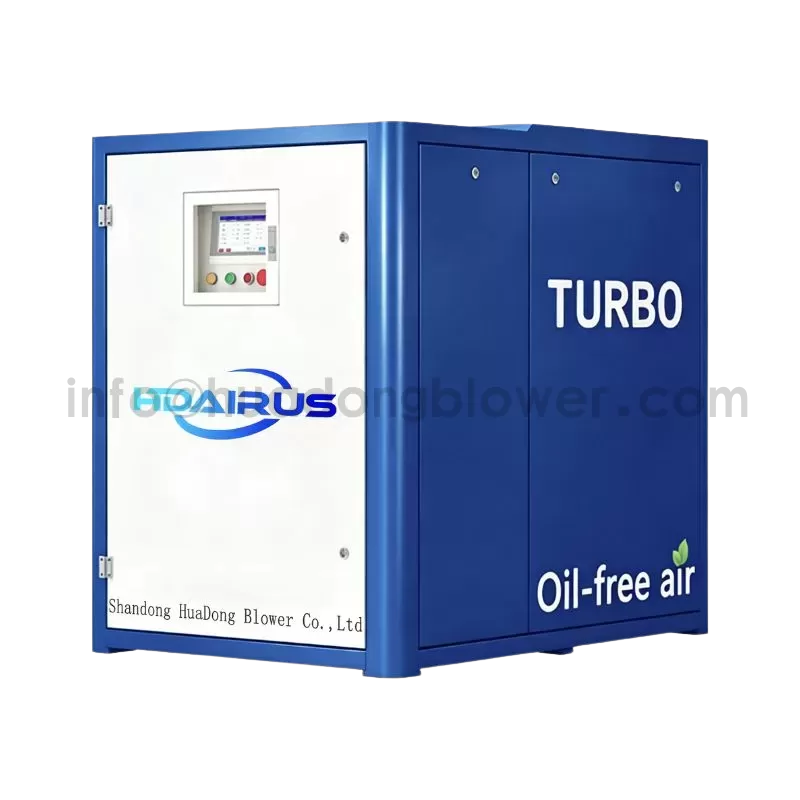
To meet the demanding requirements of long-distance cement, fly ash, and bulk powder handling, Shandong Huadong Blower Co., Ltd. manufactures state-of-the-art positive displacement screw blowers.
Through our dedicated HDAirus equipment engineering division, we deliver customized, heavy-duty pneumatic conveying blower packages designed for continuous industrial duty.
Engineering Highlights of HDAirus Screw Blowers
Advanced Rotor Profile: Precision-machined screw rotors with micro-clearances yield maximum volumetric efficiency without requiring oil lubrication in the compression chamber.
100% Oil-Free Conveying Air: ISO 8573-1 Class 0 certified oil-free air prevents oil contamination of bulk cement or fly ash, eliminating moisture-oil clumping inside silos and conveying lines.
Heavy-Duty Construction: Heavy-walled cast iron housing with high-durability bearings ensures 24/7 reliability in dusty, aggressive industrial environments.
Turnkey Control Integration: Optional smart variable speed drive (VSD) systems adjust air volume on the fly based on real-time tonnage feed rates, maximizing power efficiency across variable plant production schedules.
By upgrading long-distance bulk transport lines with HDAirus high-pressure screw blowers, bulk handling facilities eliminate line plugging, dramatically lower energy bills, and achieve total investment recovery in under a year.
Recommended Products