Upgrading Aeration Basins: Real-World Energy Savings with Maglev Turbo Blowers in Municipal Wastewater Plants
Release time: Sep.03.2026
Click volume: Views
In municipal wastewater treatment plants (WWTPs), the secondary biological treatment stage—specifically the aeration basin—is the single largest consumer of electricity. Biological aeration typically accounts for 50% to 70% of a plant's total operational energy expenditure. Historically, facilities relied on traditional positive displacement (Roots) blowers or gear-driven multi-stage centrifugal blowers. While robust, these legacy machines suffer from significant mechanical friction losses, oil contamination risks, and poor wire-to-air efficiency under fluctuating process loads.
Upgrading legacy aeration basins with Magnetic Levitation (Maglev) High-Speed Turbo Blowers represents the most effective capital upgrade for reducing municipal WWTP carbon footprints and operating costs. By suspending the high-speed rotor in an electromagnetic field, Maglev technology eliminates mechanical contact, dynamic friction, and oil lubrication requirements, yielding real-world energy savings of 30% to 40%.
1. Core Energy Drivers in Municipal Aeration Basins
Biological wastewater treatment relies on aerobic microorganisms to metabolize organic pollutants (BOD/COD) and convert ammonia to nitrate (nitrification). Oxygen transfer efficiency (OTE) depends on continuous airflow supplied through fine-bubble diffusers at the floor of the basin.
+-----------------------------------------------------------------------------------+
|                        MUNICIPAL WWTP ENERGY CONSUMPTION                          |
+-----------------------------------------------------------------------------------+
|  [ Biological Aeration Basins ] ===========================>  50% - 70% Total kWh |
|  [ Sludge Processing & Pumping ] =======================>  20% - 30% Total kWh    |
|  [ Clarifiers, Disinfection, Auxiliary ] ===========>  10% - 20% Total kWh        |
+-----------------------------------------------------------------------------------+
The Efficiency Gap in Legacy Blower Technologies
Mechanical Friction Losses: Traditional gearboxes, belt drives, and hydrodynamic bearings convert a substantial portion of motor input power into waste heat.
Fixed-Speed Inefficiencies: Many older installations run at fixed speeds or use restrictive throttling inlet vanes (IGVs), wasting energy when diurnal influent flows drop during off-peak night hours.
Thermal Inefficiencies: Traditional blowers generate elevated discharge air temperatures, reducing air density and lowering the effective dissolved oxygen (DO) transfer efficiency into the liquid column.
2. Comparative Technology Matrix: Legacy Blowers vs. Maglev Turbo Blowers
Technical & Operational Metric | Rotary Lobe (Roots) Blower | Multi-Stage Centrifugal | Maglev High-Speed Turbo Blower |
Drive & Bearing System | Belts/Gears + Oil Lubricated | Gearbox + Fluid Bearings | Direct-Drive + Magnetic Levitation |
Wire-to-Air Efficiency | 50% – 65% | 60% – 70% | 78% – 85%+ |
Specific Energy (kWh/kg O2) | 1.4 – 1.8 | 1.2 – 1.5 | 0.75 – 1.0 |
Turndown Range | Limited (70% – 100%) | Moderate (60% – 100%) | Wide (40% – 100%) |
Lubrication Maintenance | High (Periodic Oil/Filter Changes) | High (Oil Seals, Gearbox Inspections) | Zero Oil (100% Oil-Free Operation) |
Acoustic Noise Level | 85 – 105 dBA (Requires Enclosure) | 85 – 95 dBA | < 75 – 80 dBA (Ultra-Quiet) |
Heat Dissipation Loss | High Mechanical Heat Loss | Moderate Mechanical Heat Loss | Minimal (Air/Water-Cooled PMSM Motor) |
3. Real-World Physics of Maglev Energy Savings
1. Permanent Magnet Synchronous Motor (PMSM) & Direct Drive
Maglev turbo blowers eliminate gears, belts, and couplings. The high-precision aluminum/titanium alloy impeller is mounted directly onto the PMSM rotor shaft. Operating at speeds between 20,000 and 60,000 RPM, the system achieves motor electrical efficiencies exceeding 97%.
2. Active Magnetic Bearings (AMB) with Zero Mechanical Contact
When powered, active magnetic bearings lift the rotor assembly in mid-air with position sensors adjusting the electromagnetic field thousands of times per second.
Mechanical friction loss in Maglev systems is essentially zero kW. This contrast is dramatic compared to conventional journal bearings, which can consume 5% to 10% of total shaft power purely overcoming fluid shear and mechanical resistance.
   [ Active Magnetic Bearings ]  <--->  [ Position Sensors (10 kHz Sampling) ]
                 |                                      |
                 +---------------> [ High-Speed PMSM Shaft ] <---------------+
                                         |
                            [ Directly Coupled Impeller ]
                                         |
                          [ 100% Oil-Free Aeration Output ]
3. Smart Turndown Matched to Diurnal Loading
Municipal influent flow rate and organic loading follow a sinusoidal curve over 24 hours. Maglev turbo blowers feature integrated Variable Frequency Drives (VFDs) that adjust impeller speed dynamically in response to real-time Dissolved Oxygen (DO) probe signals in the basin.
Peak Load (08:00–12:00 / 18:00–21:00): Blower operates at 85%–100% speed to maintain target DO (e.g., 2.0 mg/L).
Off-Peak Night Load (01:00–05:00): Blower ramps down to 40%–50% speed. Because fan power consumption drops exponentially as speed decreases (following the cubic relationship of fan laws), reducing the speed by half cuts power draw by nearly 85%.
4. Financial Return on Investment (ROI) Case Analysis
Baseline Plant Parameters
Municipal WWTP Capacity: 100,000 m3/day
Aeration Air Demand: 180 Nm3/min (10,800 Nm3/hr)
Operating Pressure: 58.8 kPa (6.0 m water column depth)
Electricity Tariff: $0.12 / kWh
Operating Hours: 8,760 hours/year (Continuous 24/7)
Energy & Cost Comparison Calculation
+-----------------------------------------------------------------------------------+
|                        ANNUAL ELECTRICITY COST COMPARISON                         |
+-----------------------------------------------------------------------------------+
|  Legacy Roots Blowers:           310 kW  --->  $325,872 / Year                     |
|  Maglev Turbo Blowers:           198 kW  --->  $208,137 / Year                     |
|  -------------------------------------------------------------------------------  |
|  NET ANNUAL ENERGY SAVINGS:      112 kW  --->  $117,735 / Year (36.1% Reduction)  |
+-----------------------------------------------------------------------------------+
ROI & Payback Timeline
Capital Expenditure (CapEx) Differential: Including blower unit, integrated VFD, smart control panel, and installation adjustments ≈ $140,000 – $160,000.
Annual Energy Savings (OpEx): $117,735 / year.
Maintenance Cost Reduction: Eliminating oil changes, mechanical seal replacements, and belt tensioning saves an additional ≈ $6,000 – $8,000 / year.
Simple Payback Period: Dividing the $150,000 investment by $124,000 in total annual savings yields a payback period of approximately 1.21 Years (14.5 Months).
5. Next-Generation Maglev Solutions by Shandong Huadong Blower Co., Ltd.
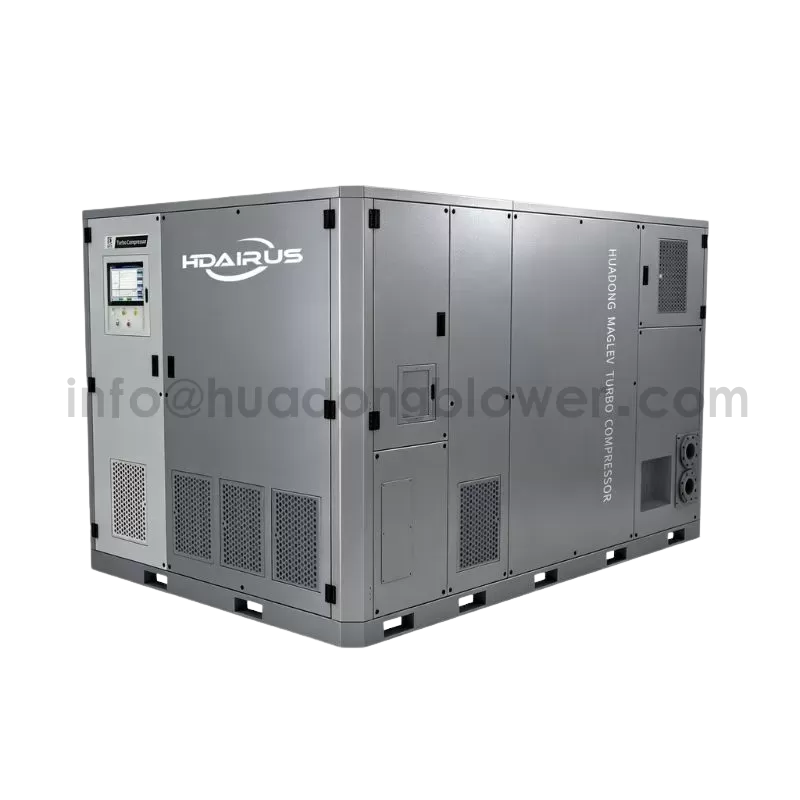
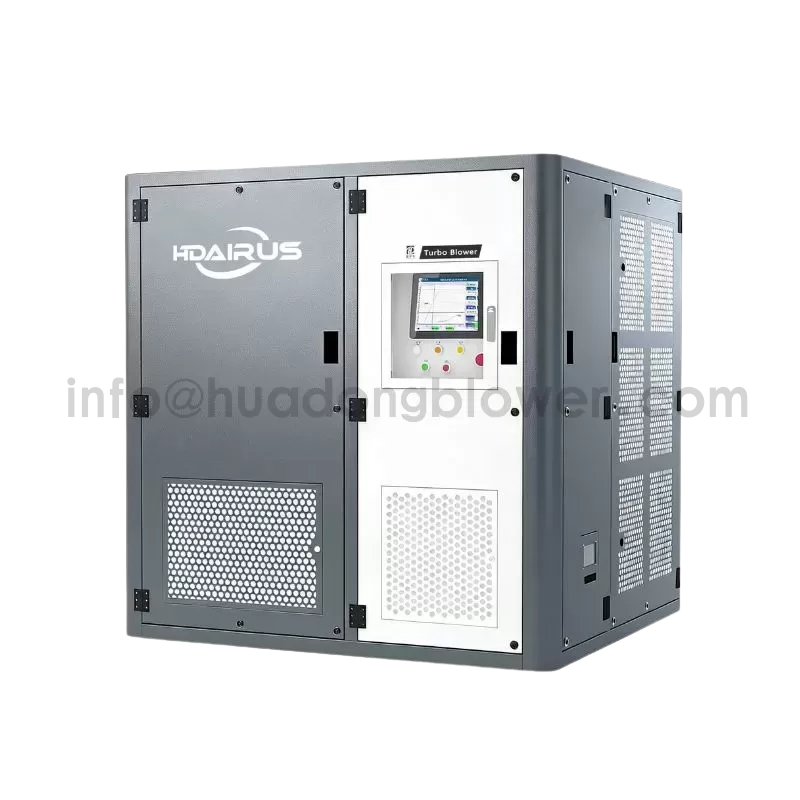
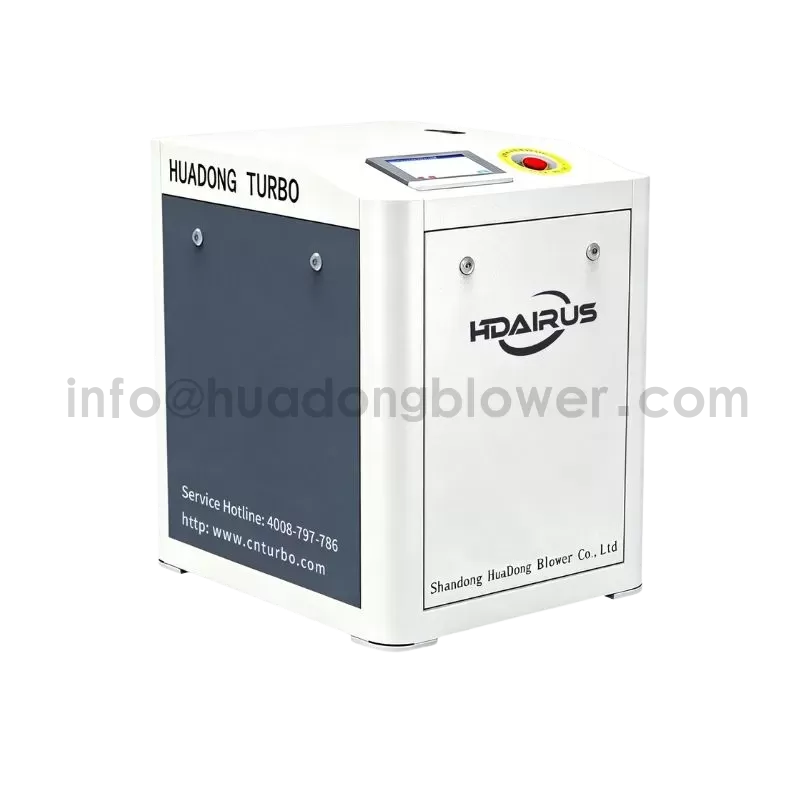
To help municipal authorities, plant operators, and environmental engineering contractors achieve decarbonization targets and lower operating costs, Shandong Huadong Blower Co., Ltd. manufactures industry-leading high-speed magnetic levitation turbo blowers.
Through our specialized HDAirus industrial equipment division, we engineer complete turnkey Maglev blower systems tailored specifically for biological wastewater treatment applications.
Engineering Highlights of HDAirus Maglev Turbo Blowers
Advanced Aerodynamic Design: 3D ternary flow forged aluminum-titanium impellers achieve polytropic stage efficiencies up to 87%.
Integrated Smart Control: Onboard PLC with integrated VFD supports Modbus, Profinet, and Ethernet/IP protocols, enabling seamless integration with SCADA systems for automated DO feedback control.
UPS Power Failure Protection: Built-in energy feedback system converts kinetic rotor energy into electrical energy during sudden grid outages, ensuring safe, controlled rotor landing without bearing damage.
100% Oil-Free Certification: Eliminates any risk of oil contamination in fine-bubble diffuser membranes, extending diffuser lifespan and maintaining high oxygen transfer efficiency over time.
By replacing outdated aeration equipment with HDAirus Maglev turbo blowers, municipal facilities ensure long-term regulatory compliance, maximize energy performance, and achieve rapid capital payback.
Recommended Products