Maintenance Protocols for Maglev Turbo Blowers
Release time: Jun.04.2026
Click volume: Views
The Paradigm Shift: Reengineering the Maintenance Concept
In traditional industrial plants, the word "maintenance" conjures up images of greasy hands, emergency weekend shutdowns, complex oil piping diagrams, and continuous spare parts expenditures. For legacy positive displacement machinery like rotary lobe or screw blowers, rigid upkeep is a survival requirement to prevent physical metal-on-metal seizure.
Magnetic Levitation (Maglev) Turbo Blowers completely rewrite this narrative.
Because the high-speed shaft floats entirely inside a digitally controlled electromagnetic field, there is zero physical contact, zero friction, and zero oil lubrication inside the machine. By eliminating the parts that wear out, Maglev blowers eliminate over 90% of the maintenance tasks associated with traditional utilities.
However, "low maintenance" does not mean "zero attention." To ensure your high-speed turbomachinery operates at peak thermodynamic efficiency for decades, your facility should follow a highly simplified, non-invasive maintenance routine.
The Core Upkeep: Simplified Maintenance Steps
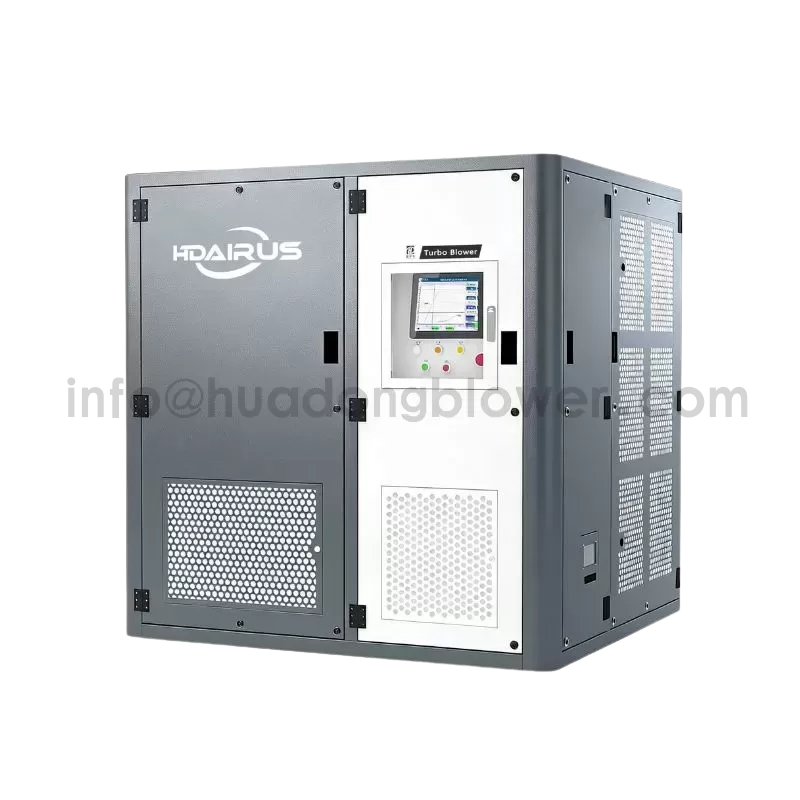
Because there are no oil sumps to drain, no mechanical gears to align, and no drive belts to tension, the physical maintenance checklist for an HDAirus Maglev turbo blower is narrowed down to just a few clean, straightforward tasks.
1.Inspect and Replace the Air Intake Filter Element:Every 1 to 3 months (Site-dependent)
The single most important task. High-speed centrifugal impellers rotate at tens of thousands of RPM and require clean intake air to prevent particulate erosion. Simply slide out the ambient air filter element. If dusty, clean with low-pressure compressed air; if heavily loaded, slide in a fresh replacement. Takes under 5 minutes.
2.Clean the Enclosure Vent Filters:Every 3 months
The internal Variable Frequency Drive (VFD) and active magnetic bearing (AMB) control panels generate heat during operation and are cooled by auxiliary cooling fans. Wipe down or replace the small mesh filters protecting the electrical cabinet air vents to ensure uninterrupted electronic cooling airflow.
3.Monitor the Active Magnetic Bearing (AMB) Calibration:Real-time via Digital HMI Panel
No physical tools required. Check the digital touch screen or your central SCADA control room dashboard. The integrated position sensors track the shaft line thousands of times per second. Ensure the digital readout shows the shaft centering within target micrometer tolerances ($<\mu\text{m}$).
4.Inspect Electrical Terminal Connections:Annually / During scheduled plant shutdowns
With the unit completely locked out and powered down, open the rear electrical access door. Visually check for any loose power cable terminations or sensor wiring harnesses caused by surrounding plant floor micro-vibrations. Tighten to spec if necessary.
Why Maglev Maintenance is Significantly Simpler
To put this into perspective for plant managers and procurement teams, it helps to compare the routine overhead of an HDAirus Maglev unit against the heavy maintenance cycles required by traditional lubricated positive displacement machinery.
Maintenance Parameter | Traditional Lobe / Screw Blowers | HDAirus Maglev Turbo Blowers |
Lubrication Media | Requires 5–20 liters of high-cost synthetic oil. | Absolute Zero. No oil or grease allowed in the machine. |
Wear Components | Mechanical bearings, timing gears, shaft seals, driving belts. | None. The rotating assembly floats in a magnetic field. |
Oil-Air Separators | Must be replaced every 2,000–4,000 operating hours. | Eliminated. There is no oil to separate from the air stream. |
Physical Labor Time | 4 to 8 hours per service tool-down cycle. | Less than 10 minutes (Filter swap only). |
Risk of Human Error | High (Over-greasing, wrong oil viscosity, misalignment). | Extremely Low (Controlled via automated digital software). |
Recommended Products