The Ultimate Guide to Airfoil Bearing Turbo Blower Technology
Release time: May.28.2026
Click volume: Views
The High-Speed Aerodynamic Revolution
For decades, industrial air delivery relied heavily on mechanical positive displacement. While rotary lobe and screw blowers served their purpose, their performance boundary was structurally limited by physical friction, gear wear, and continuous lubrication overhead.
Airfoil Bearing Turbo Blowers represent a complete departure from volumetric compression. These high-speed, dynamic machines utilize aerodynamic principles derived from aerospace engineering to achieve frictionless, ultra-high-efficiency compression.
By riding on a self-generated cushion of air rather than physical rolling element bearings, airfoil turbo blowers operate at rotational velocities exceeding 50,000 RPM. For modern manufacturing plants, municipal wastewater facilities, and chemical processing loops, this technology slashes utility energy consumption by up to 35% while engineering mechanical wear completely out of the process line.
The Physics of Aerodynamic Lift: How Airfoil Bearings Work
The defining innovation of an airfoil turbo blower is its bearing architecture. Unlike magnetic levitation systems, which require complex external sensors and a constant electrical power draw to suspend a shaft, airfoil bearings are completely self-sustaining passive dynamic systems.
An airfoil bearing assembly consists of three primary layers wrapped around the high-speed rotating shaft (journal):
l The Smooth Journal Sleeve: The precision-ground surface of the rotating shaft.
l The Top Foil: A smooth, flexible stainless steel sheet coated with a high-durability dry-film lubricant that directly faces the shaft.
l The Bump Foil: A corrugated, wave-shaped spring steel layer positioned beneath the top foil that provides structural elasticity and dampens rotor vibrations.
The Liftoff Phenomenon (Hydrodynamic Air Film)
When the blower is at rest, the shaft sits directly on the lubricated top foil. As the permanent magnet motor receives power and begins to spin, the viscous shearing action of the surrounding air drags molecules into the converging wedge-shaped gap between the shaft and the foil.
l At Low Speeds ($<5,000$ RPM): The shaft experiences a brief moment of sliding contact, protected by the dry-film surface coating.
l At Operational Liftoff Speed: The velocity of the air molecules creates a high-pressure dynamic cushion. This aerodynamic pressure pushes the flexible top foil outward against the elastic bump foil.
l Frictionless Equilibrium: The shaft lifts off completely, floating on a high-pressure film of pure air. At this stage, physical contact drops to absolute zero, and mechanical friction is replaced by minor aerodynamic drag.
Anatomy of a High-Performance Turbo Blower Package
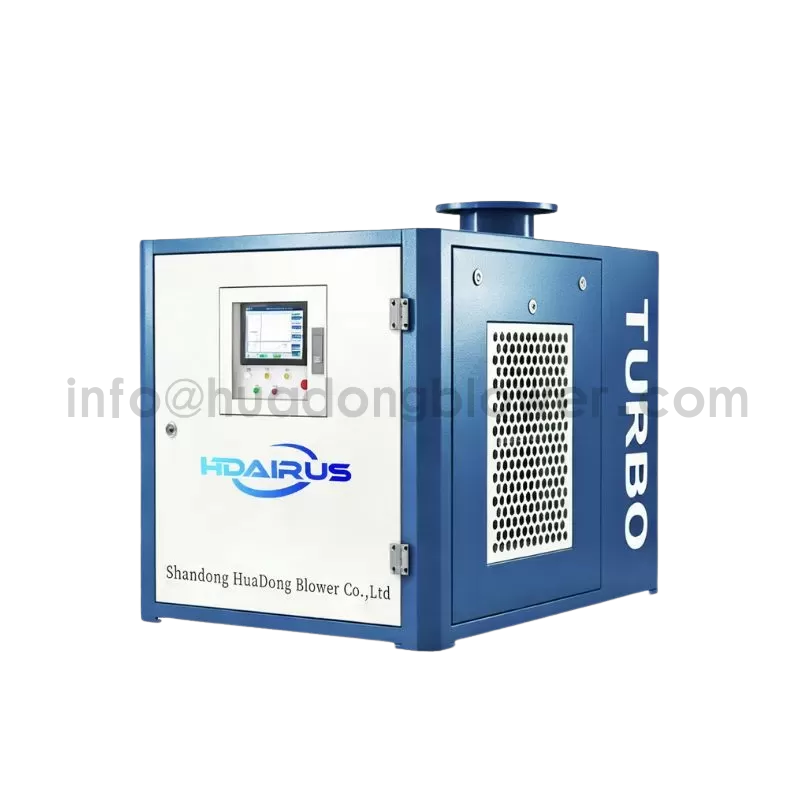
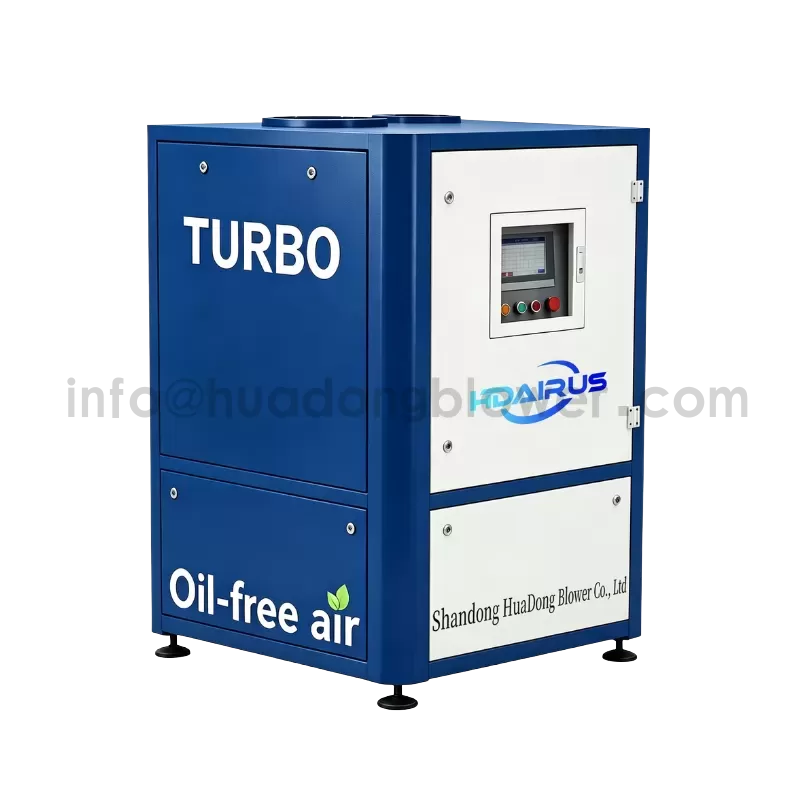
An airfoil turbo blower is an highly integrated mechatronic system. Achieving stable, continuous duty at ultra-high speeds requires three core technologies to function in perfect harmony:
1. High-Precision Aerodynamic Impellers
The compression work is performed by a three-dimensionally machined centrifugal impeller. Frequently forged from aviation-grade aluminum alloys or titanium, these impellers feature backward-curved blade profiles optimized via Computational Fluid Dynamics (CFD). The blade geometry kinetically accelerates incoming air molecules radially outward, converting raw velocity into static pressure within a precision volute casing.
2. Permanent Magnet Synchronous Motors (PMSM)
Traditional induction motors are too heavy and inefficient to sustain the high frequencies required for turbo machinery. Airfoil blowers utilize an integrated PMSM direct-drive rotor. Neodymium-iron-boron (NdFeB) permanent magnets are embedded directly into the levitating shaft line. This design yields a motor efficiency profile exceeding 95% to 98%, completely eliminating the copper rotor losses common in legacy factories.
3. Integrated Variable Frequency Drives (VFD)
Because an aerodynamic blower relies on dynamic kinetic energy, its discharge pressure and airflow are governed directly by its rotational speed. An integrated high-frequency VFD functions as the brains of the machine. It converts incoming factory grid power into a high-frequency AC signal, allowing the digital controller to adjust shaft speeds by fractions of a percent to track shifting system resistances instantly.
Core Operational Advantages for Modern Infrastructure
Upgrading processing utilities to airfoil turbo blower packages delivers immediate, quantifiable returns across four operational categories:
u Maximum Energy Conservation: By eradicating transmission losses (belts and gearboxes) and eliminating physical bearing friction, airfoil turbo blowers lower net plant electrical demands by 20% to 35%. In continuous-duty applications like wastewater aeration, the asset frequently pays for its initial capital expenditure within 18 to 24 months through utility bill reductions alone.
u Natively 100% Oil-Free Delivery: Because the shaft levitates entirely on a fluid film of ambient air, the machine enclosure houses zero lubrication oil, zero grease sumps, and zero oil pumps. This absolute purity ensures that discharge air cannot introduce hydrocarbon mist into your process stream, safeguarding sensitive pharmaceutical reactants, food products, or downstream ultrafiltration membranes from chemical fouling.
u Silent Industrial Footprint: Traditional blowers emit low-frequency structural pulses that require massive concrete silencer blocks and heavy sound isolation walls. Airfoil turbo blowers operate with an incredibly low acoustic footprint, typically hovering below 75 dBA. The high-frequency hum is easily managed within a compact integrated enclosure, creating a safer, OSHA-compliant workspace for facility operators.
u Maintenance-Free Lifecycle: With mechanical friction engineered out of the machine, there are no gears to realign, no oil levels to monitor, and no mechanical seals to replace. The preventative maintenance protocol is stripped down to a single task: periodically sliding out the intake air filter element and replacing it to ensure the incoming air path remains free of abrasive particulate matter.
HDAirus Material Selection and Technical Compliance
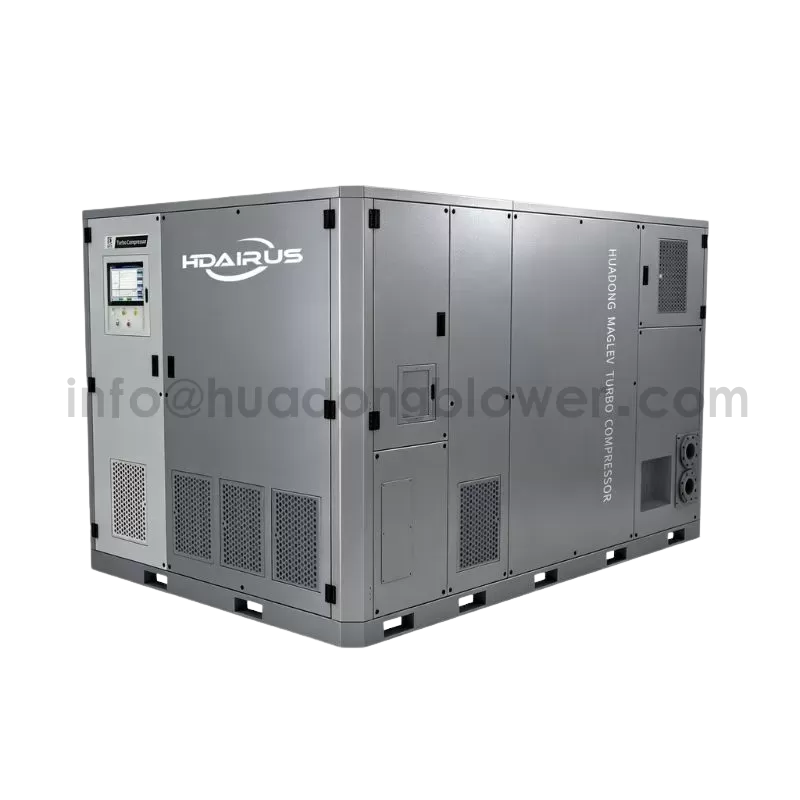
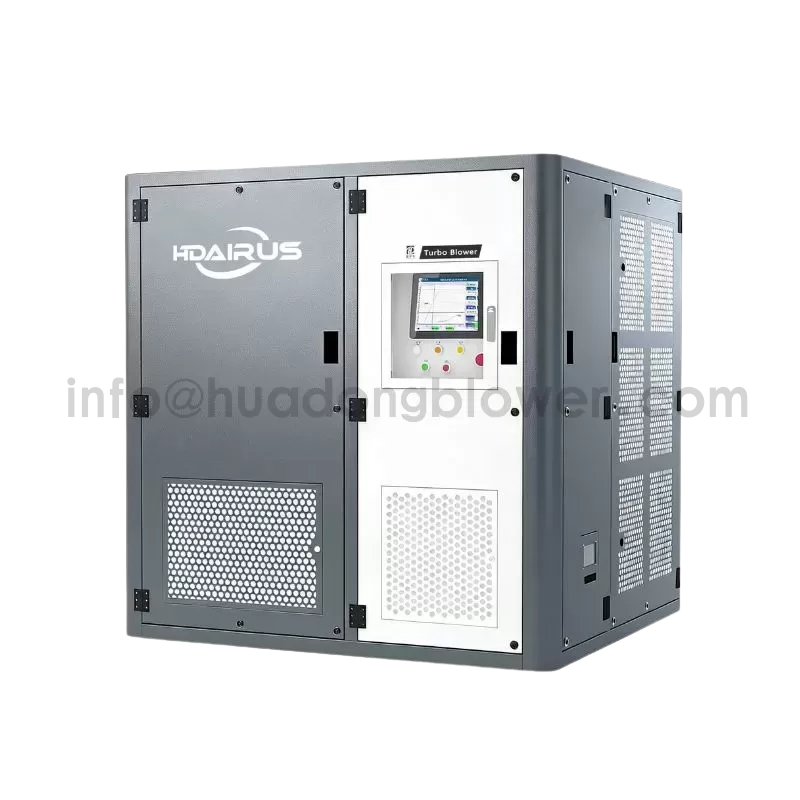
Operating industrial machinery at velocities exceeding tens of thousands of revolutions per minute leaves zero margin for manufacturing error. HDAirus engineers its high-speed airfoil bearing turbo blowers under a rigorous ISO 9001 certified quality management framework, utilizing top-tier industrial metallurgy:
l Heavy High-Strength Cast Iron: Used for the main outer structural scroll and base framing to provide maximum rigid stability and excellent acoustic dampening characteristics.
l Premium Stainless Steel and Precision Alloys: Applied across all internal gas-path components to completely eliminate moisture-driven oxidation, pitting, or rust formation from ambient atmospheric intake.
l High-Quality Specialized Coatings: The dynamic faces of our foil bearings are treated with advanced, high-temperature solid lubricants (such as specialized Teflon or diamond-like carbon matrixes) to minimize wear during the brief liftoff and touchdown cycles.
To streamline international procurement and guarantee hassle-free integration into global municipal and industrial projects, all HDAirus turbo blower packages carry complete CE and EAC certifications. This ensures full compliance with the strict technical, electrical, and mechanical safety codes enforced across major international industrial authorities. Partner with HDAirus to anchor your facility with the pinnacle of modern aerodynamic air delivery technology.
Recommended Products